Ever marvel at how quickly a toddler picks up a new language, seemingly without effort, while you've been slogging through verb conjugations for years? It's not just your imagination. The scientific community has long explored the concept of the Critical Period Hypothesis (CPH), a fascinating theory suggesting a biological "window of opportunity" for language acquisition. While it might sound like bad news for adult learners, the story is far more nuanced, blending a touch of neurobiology with a healthy dose of hope.
The Brain's Early Bird Special: Why Childhood is Golden
Imagine your brain as a super-flexible computer, especially in the early years. From birth until roughly puberty, our brains exhibit incredible neuroplasticity. This means new neural connections can form rapidly and efficiently, making language absorption feel almost effortless. Children aren't just memorizing words; they're intuitively grasping complex grammatical structures, intricate sound systems (phonemes), and the rhythm of a language without ever cracking a textbook.
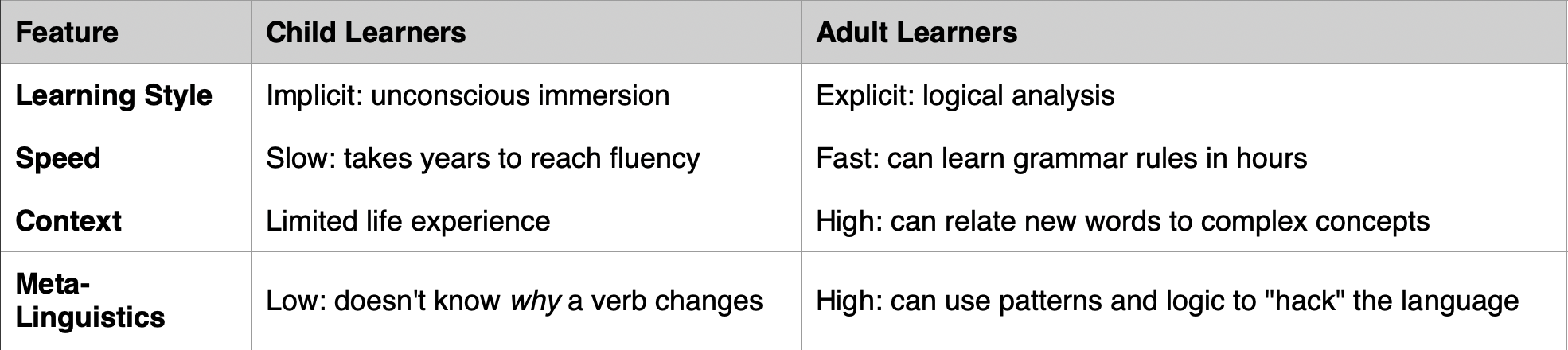
A key factor here is where language "lives" in a child's brain. Often, it's integrated into the basal ganglia, the same region responsible for deep-seated motor habits like walking or riding a bike. This makes their linguistic knowledge almost instinctual. Contrast this with adult learners, who often engage more prefrontal cortex activity – the "conscious thought" part of the brain – to grapple with grammar rules.
Perhaps the most visible manifestation of the CPH is the accent. Children exposed to a new language before puberty can typically achieve native-like pronunciation. After this critical period, the brain's ability to perfectly replicate new sounds diminishes, making it incredibly challenging for adults to shed their native accent entirely. It's not about intelligence; it's about neural wiring.
The Adult Advantage: Smarter, Faster, But Not Always Flawless
Before you throw in your language-learning towel, here's the good news: the "critical period" isn't a brick wall, but more like a changing landscape. While children might be better at implicit learning (absorbing subconsciously), adults excel at explicit learning.
The "Adult Advantage"
Adults bring a powerful arsenal to the language learning battlefield:
Cognitive Maturity: We can understand abstract grammar rules, identify patterns, and make logical deductions about how a language works.
Existing Knowledge Base: We can connect new vocabulary to a vast network of life experiences and concepts, speeding up comprehension.
Meta-Linguistic Awareness: We can analyze language, understand why certain structures exist, and consciously apply strategies to improve.
Motivation & Discipline: Adults can set goals, manage their time, and push through plateaus with grit that a child simply doesn't possess.
This means adults often learn faster in the initial stages. They can grasp complex grammar in hours, whereas a child takes years of immersion. The challenge isn't learning, but rather achieving that elusive native-like fluency and pronunciation.
The "Fossilization" Effect and How to Beat It
One interesting phenomenon adults face is fossilization. This occurs when an adult learner reaches a point where they can communicate effectively, and their brain, being wonderfully efficient, decides "good enough!" It stops expending energy to correct persistent errors, like that tricky plural ending or an incorrect preposition. The errors become "fossilized" into their linguistic system.
Overcoming fossilization requires conscious, deliberate effort. It means actively seeking out feedback, paying meticulous attention to detail, and often feeling uncomfortable as you break old habits. It's about reactivating that neuroplasticity through focused practice.
The Takeaway: It's Never Too Late
So, while children may have a biological head start, the Critical Period Hypothesis doesn't doom adult language learners to failure. It simply means the path to mastery is different. Adults leverage their cognitive strengths, their explicit learning abilities, and their sheer willpower to achieve fluency.
Learning a language as an adult might require more deliberate effort to mimic that childhood "sponge" effect, but the rewards are immense. You're not just learning words; you're expanding your mind, accessing new cultures, and even, as the Sapir-Whorf Hypothesis suggests, potentially changing the way you think.
Don't let the "critical period" discourage you. Embrace your adult learning advantages, stay curious, and keep pushing those neural boundaries. The journey is challenging, but profoundly enriching. Here is an image for your blog post! `
Improve your language skills effortlessly with personalized, contextual vocabulary and real-time feedback and corrections. Practice naturally through chat-based, real-life conversations, accessible via web and Telegram. Experience efficient AI-powered learning with flashcards for vocabulary building, delivering quick results with minimal effort.