Language is not static. It’s a living, breathing thing that shifts with global economics, migration patterns, and, most importantly, demographics. When you select a language to learn, you are making a strategic bet on your future.
Why do we look 50 years ahead to 2075? Because language learning is a long-term compound interest investment. Short-term trends can be noisy, but a 50-year horizon reveals the undeniable power of demographics. This timeline covers the bulk of a modern career and the prime years of the next generation. By understanding the destination, you can better navigate the journey starting today. So, let’s run a thought experiment: if we follow the current trend lines, what will the global linguistic map look like when today's toddlers are running the boardroom?
The Starting Line: Today’s Giants (2025)
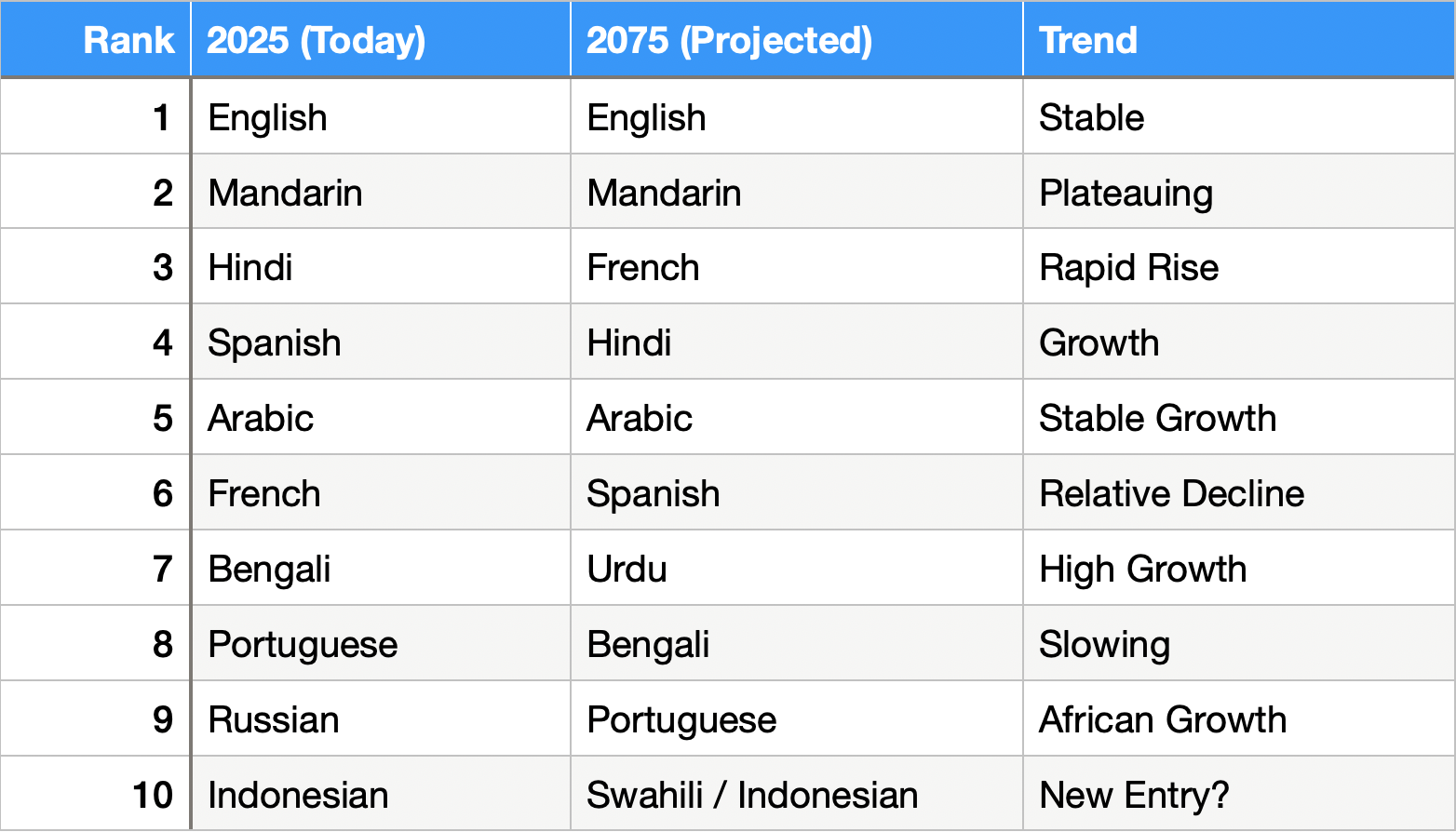
Before we look forward, let’s ground ourselves in the present. Today, the world’s most spoken languages (by total number of speakers, native and non-native) are dominated by established economic powers and massive populations:
Languages like French, Bengali, Portuguese, Russian, and Indonesian round out the top ten. But the demographic engines driving these languages are changing gears.
Ranking of Languages by Speakers and Projection for 2075
The Engine of Change: Who is Growing?
To predict the future, you have to look at birth rates. Where are populations booming, and where are they shrinking?
The Shrinking East & North: China, Japan, Russia, and much of Europe are facing demographic declines and aging populations. This puts a natural cap on the growth of native speakers for languages like Mandarin, Russian, Japanese, German, and Italian.
The Stabilizing Americas: Latin America’s birth rates have dropped significantly. While Spanish remains massive, its explosive growth phase is ending.
The Booming South: The real action over the next 50 years will be in South Asia (India, Pakistan) and, most dramatically, Sub-Saharan Africa.
This shift is going to completely reshuffle the linguistic deck.
The Forecast: The Projected Top Languages of 2075
Fast-forward 50 years. Based on UN population projections and current linguistic trends, here is the likely new world order:
1. English (Still the King)
Demographics in native English countries are slow, but English has momentum that defies birth rates. It remains the default second language for science, business, and the internet globally. Crucially, it is an official language in high-growth African nations like Nigeria.
China’s population will shrink significantly by 2075. However, its starting base of 1.2 billion is so massive—and its economic weight so profound—that it will easily hold the #2 spot, even as its speaker count plateaus.
This is the biggest story of the next half-century. While France’s population is stable, the French language is expanding explosively in the fastest-growing region on Earth: Francophone Africa (countries like DR Congo, Senegal, and Cameroon). Some projections suggest French speaker numbers could triple, vaulting it from #6 today to a powerful #3 by 2075.
India is now the world's most populous nation. While its growth is slowing, the sheer momentum will solidify Hindi as a global juggernaut for decades to come.
High birth rates in key countries like Egypt and Iraq will ensure Arabic continues its steady upward trajectory, cementing its place in the top five.
The Shifters:
By 2075, we expect Spanish to drop slightly in relative rankings due to stabilizing demographics. Urdu (Pakistan) will likely surge into the top tier. Portuguese will remain vital thanks to population growth in Angola and Mozambique, balancing out Brazil's stagnation. Meanwhile, Russian faces a steep demographic challenge and may drop out of the top 10 entirely.
What This Means for You: Choosing Your Learning Path
So, how do you use this 50-year forecast to choose your next language today? It depends on your goals.
1. The "Future Titans" (For long-term strategic advantage)
If you want to speak the languages of the fastest-growing demographics and emerging markets, look toward the global South.
2. The Economic Stalwarts (Where demographics don't tell the whole story)
Just because a population is shrinking doesn't mean the language is losing importance. Countries like Japan, Germany, and South Korea remain immense economic and technological powerhouses. Their languages remain essential for business, engineering, and culture.
Some languages won't dominate the globe globally but will remain incredibly powerful in specific, vital regions.
Picks: Turkish (connecting Europe and Asia), Vietnamese (a Southeast Asian manufacturing hub), Malay (key to ASEAN business).
The Best Time to Start is Now
The world of 2075 will sound different than the world of today. French may eventually be spoken by more people than Spanish, and Hindi might become as common in international business as Mandarin. But no matter which future you are preparing for, language skills will remain a critical tool for achieving your goals. Whether you’re betting on the demographic boom of French, the economic might of German, or the cultural depth of Japanese, don’t wait 50 years to get started.
Pick your future language and start your first lesson today!
Posted on 4th of December, 2025
Blog Posts
How Latin secretly lives on
Ancient Rome’s imprint on Spanish, French, Italian…
Improve your language skills effortlessly with personalized, contextual vocabulary and real-time feedback and corrections. Practice naturally through chat-based, real-life conversations, accessible via web and Telegram. Experience efficient AI-powered learning with flashcards for vocabulary building, delivering quick results with minimal effort.